Welcome to the AGILE Data Center Home Page at SSDC
These pages provide updated information and services in support to the general scientific community for the mission AGILE, which is a small Scientific Mission of the Italian Space Agency (ASI) with participation of INFN, IASF/INAF and CIFS .
AGILE is devoted to gamma-ray astrophysics and it is a first and unique combination of a gamma-ray (AGILE-GRID) and a hard X-ray (SuperAGILE) instrument, for the simultaneous detection and imaging of photons in the 30 MeV - 50 GeV and in the 18 - 60 keV energy ranges.
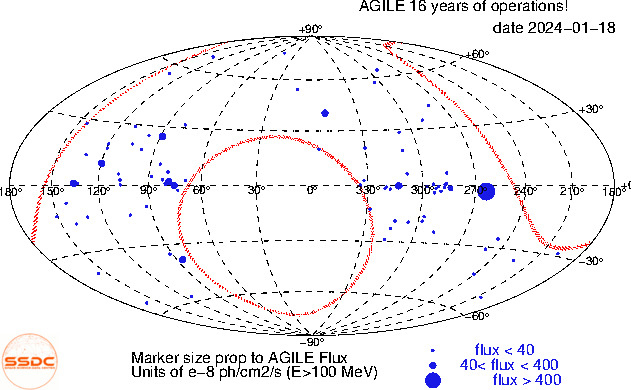
AGILE has been operating nominally for more than 16 years, providing valuable data and important scientific results.
AGILE operations:
Launch date: 23 April, 2007 - Re-entry date: 14 February, 2024
Science observations ended on 18 January, 2024
Planned Nominal Phase: 2 + 2 extended years
Elapsed: 16 years and 10 months in orbit (6.141 days)
The AGILE Mission Board (AMB) has executive power overseeing all the scientific matters of the AGILE Mission and is composed of:
- AGILE Principal Investigator: Marco Tavani, INAF Rome (Chair)
- ASI Project Scientist: Paolo Giommi, ASI
- ASI Mission Director: Giovanni Valentini, ASI
(Former ASI Mission Directors: Luca Salotti: Apr 2007 - Sep 2010, Giovanni Valentini: Sep 2010 - Jan 2015,
Fabio D'Amico: Jan 2015 - Jun 2023)
- AGILE Co-Principal Investigator: Guido Barbiellini, INFN Trieste
- 1 ASI representative: Elisabetta Tommasi di Vignano
(Former ASI representative: Sergio Colafrancesco up to June, 2010)
- INAF Project Scientist: Carlotta Pittori (from November 10, 2020)